
Have you ever heard of extensive reading? It’s a great way to study a language alone. Not only can you improve your reading speed, but you can also build your vocabulary and even grammar.
So what is extensive reading? Extensive reading (ER) is a kind of reading where you do a lot of reading at a lower language level (than other kinds of reading eg. intensive reading). In other words, the reading uses easier grammar, sentence structure, and vocabulary. It is the level where you understand almost all of the content (about 97%). So, for vocabulary, that’s about 3 new words for every 100 words. At this level you should be able to read without stopping to check a dictionary. You naturally learn any new language from its context (the language around it). But the key is to read a lot at this level.
One easy way to check your reading level is to use the the 5-figure rule below (recommended by the Extensive Reading Foundation):
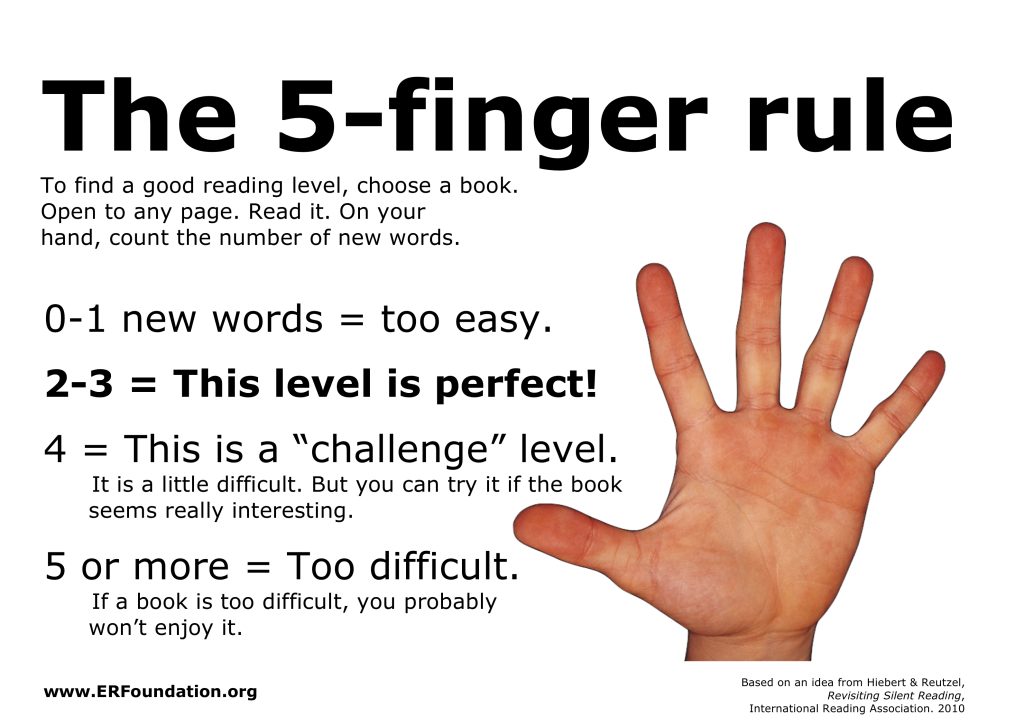
Image courtesy of the Extensive Reading Foundation
To do a lot of extensive reading, you also need to read things you enjoy. But it can be difficult to find reading that matches both your level and interests. Most reading you find in books or online may be too difficult for language learners. One way to find the right kind of extensive reading is to use graded readers. These are special books made for language learners.

Graded readers have many different levels. They also have many different types, from romance and science fiction stories to biographies and self-help topics. This makes it easy to find reading that’s interesting for you. You can find graded reader websites online. You can also find them in libraries and book shops. Don’t rush to choose your first reader. Take time to find something that matches your level and interests. Also, remember that your reading level will slowly improve over time.
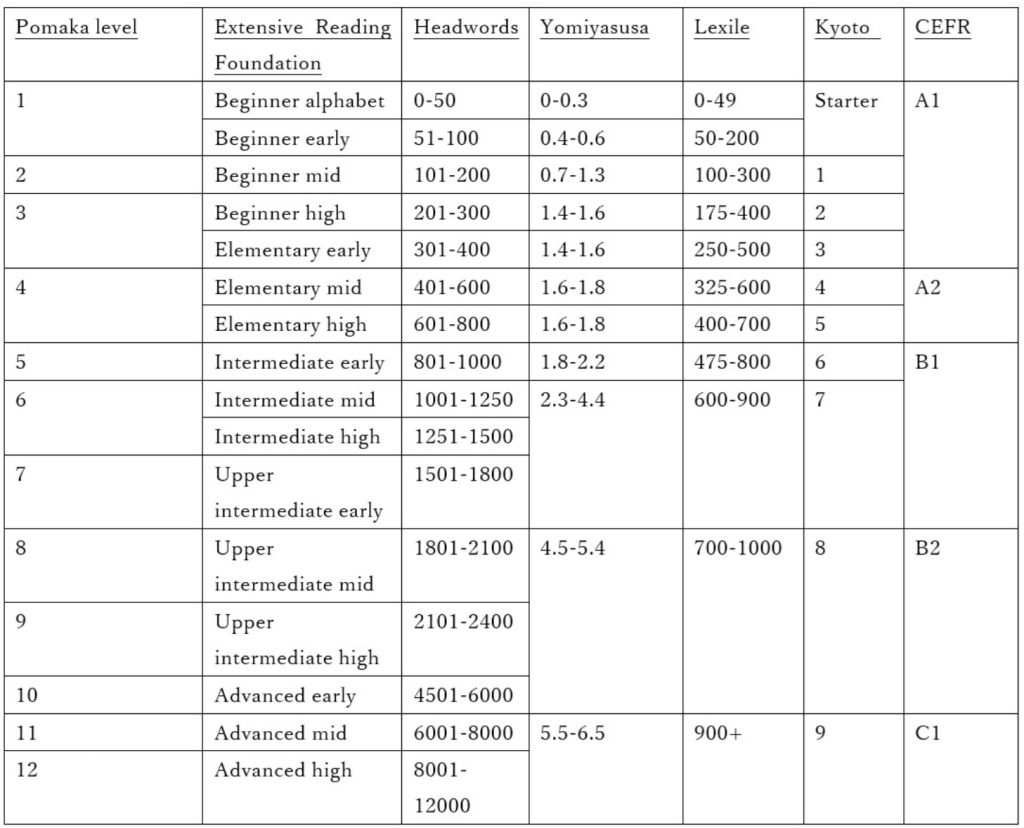
Graded reader publishers will often have different level systems. But they will usually also give their CEFR or headword level, so you can use this to compare different readers (see approximate level conversions below):
Some learners make the mistake of trying to start with extensive reading that is too difficult and then giving up. If you’re not sure about the level, then it’s always better to start with the easier reading and focus on reading more.
Finally, how much extensive reading do you need to do? Of course, more is always better. It’s best if you can read for at least 3-4 hours each week. If you’re reading things you enjoy, hopefully, you will then start to want to read more 🙂
Related links
Ten tips to get your students reading more outside class
More on determining student ER levels (link to ER Foundation website)


